Tool Overview
About Moosend
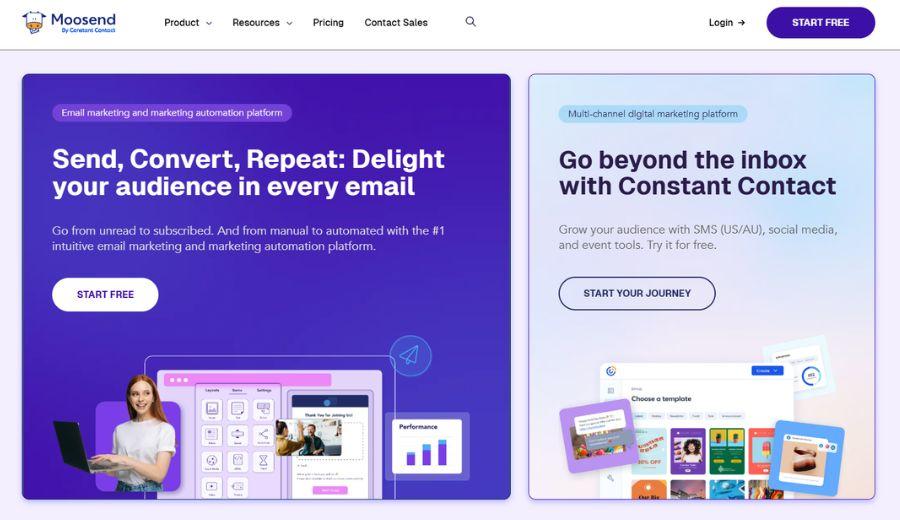
Moosend is an email marketing and marketing automation platform for creating campaigns, managing subscribers, building automated customer journeys, and measuring campaign performance.
Its feature set extends beyond newsletters. The service combines email creation, segmentation, automation, landing pages, subscription forms, website tracking, e-commerce tools, reporting, and AI-assisted features. For businesses that need automated email journeys rather than occasional broadcasts, that broader scope is the main reason to consider it.
Moosend at a Glance
| Category | Details |
|---|---|
| Primary use | Email marketing and marketing automation |
| Free access | 30-day free trial |
| Starting Pro price | $9/month for up to 500 contacts |
| Email sending | Unlimited email campaigns/sends on Pro |
| Automation | Visual workflow builder and pre-built recipes |
| AI features | AI Writer, Audience Discovery, product recommendations |
| Landing pages | Yes |
| Subscription forms | Yes |
| A/B testing | Yes |
| API | Yes |
| Integrations | 82 listed integrations |
| Transactional email | Available through SMTP/API; commercial availability varies by plan |
What Is Moosend?
Moosend is a cloud-based email marketing service that combines campaign creation, audience management, automation, and reporting.
A basic campaign can be built by importing or collecting contacts, designing an email, selecting an audience, sending the campaign, and reviewing its results.
The platform also supports website and e-commerce tracking. Events such as product views, cart activity, and purchases can be used in automation and audience management. That gives marketers a way to build campaigns around customer behavior rather than relying entirely on scheduled newsletters.
Key Features
Email Campaign Builder
Moosend includes a drag-and-drop newsletter editor and ready-made templates. It also supports custom-coded templates, image manipulation, and conditional visibility content.
The result is a workflow that accommodates both ordinary newsletter creation and campaigns where the sender needs more control over the underlying email design.
Marketing Automation
The automation system is built around triggers, conditions, and actions. Users can create workflows from scratch or start with pre-built automation recipes.
Documented use cases include welcome campaigns, abandoned-cart messages, purchase-related follow-ups, and behavior-triggered emails.
Moosend also supports triggers based on website activity, including page browsing and product views. Those capabilities depend on the relevant tracking being configured.
Segmentation and Personalization
Moosend lets marketers segment contacts using subscriber information, custom fields, tags, campaign behavior, and website activity.
Conditional visibility can also be used to show different content to different recipients.
This is useful when a single mailing list contains distinct customer groups. A retailer, for example, can combine purchase or browsing information with subscriber data when defining campaign audiences.
AI Writer
Moosend includes an AI Writer that can generate or revise text for campaign subject lines, preview text, email bodies, landing pages, and subscription forms.
The documentation also describes functions for improving copy, correcting grammar and spelling, shortening or expanding text, summarizing content, and changing tone.
There is an important qualification: Moosend’s current documentation identifies the AI Writer as Beta for a limited time.
Audience Discovery
Audience Discovery applies AI and machine-learning models to website behavior.
Moosend tracks events such as product views, add-to-cart actions, and purchases, then uses those events to create audience criteria around product or brand interest, purchase intent, and funnel stage.
The resulting information can be used in segments and automated campaigns. Moosend says its audience-discovery processing uses data from the previous three months and runs daily as new website data is collected.
Audience Discovery is not simply another name for ordinary segmentation. It is a predictive layer intended to turn behavioral data into additional audience criteria.
Current pricing places Audience Discovery among the add-ons available through Moosend+, rather than treating it as a standard Pro-only feature.
Product Recommendations
Moosend supports dynamic product recommendations in email campaigns.
Its documentation and product material describe recommendations based on e-commerce information and customer behavior, including products that are viewed, ordered, or otherwise relevant to the store’s data.
The feature is aimed at online retailers and requires the appropriate e-commerce connection and tracking.
Landing Pages and Subscription Forms
Moosend includes tools for creating landing pages and subscription forms, allowing lead capture to happen within the same marketing platform.
The free trial has restrictions: the current pricing comparison provides one unpublished subscription form and one unpublished landing page during the trial.
A/B Testing
A/B testing is included in Moosend’s campaign functionality.
The platform can test campaign variations and report the resulting performance, giving marketers a way to compare different versions rather than relying solely on assumptions about subject lines or email content.
Reporting and Analytics
Moosend provides real-time campaign reporting covering metrics such as opens, clicks, bounces, unsubscribes, and complaints.
Reporting also includes areas such as geography, devices, email heatmaps, A/B testing, website activity, and Google Analytics tracking.
The service supports custom reports, although the amount of custom reporting available depends on the plan. The current trial comparison, for example, lists one custom-report dashboard with 10 widgets.
Moosend also documents filtering for automated opens and clicks generated by bots, security scanners, and similar systems. That feature is intended to reduce the effect of automated interactions on campaign statistics.
How Moosend Works
A typical workflow is:
1. Import or collect contacts
Contacts can be imported by copying and pasting data, using TXT, CSV, or Excel files, or through supported integrations. Current documentation specifies a 40 MB limit for these file-based imports.
2. Build a campaign
Create the email in the visual editor, use a template, or work from a custom-coded design.
3. Define the audience
Use subscriber data, tags, campaign behavior, website activity, or segmentation rules to choose recipients.
4. Add automation
Create a workflow around triggers and conditions. E-commerce campaigns can use events such as product views and cart activity where the appropriate tracking is configured.
5. Send and measure
Campaign reports provide engagement and delivery-related metrics.
6. Refine future campaigns
A/B testing, segmentation, and reporting can inform subsequent campaigns.
The important point is that these stages are connected within the same service. A company can move from list management to campaign creation, automation, and measurement without moving its core email workflow between separate products.
Moosend Pricing
Moosend’s Pro plan uses contact-based pricing.
The current official pricing page shows a starting price of $9 per month for up to 500 contacts on monthly billing. Other published monthly tiers include:
| Contact limit | Monthly Pro price |
|---|---|
| Up to 500 | $9 |
| Up to 1,000 | $16 |
| Up to 2,000 | $24 |
| Up to 3,000 | $32 |
| Up to 5,000 | $48 |
| Up to 8,000 | $64 |
| Up to 10,000 | $88 |
| Up to 25,000 | $160 |
| Up to 50,000 | $315 |
Moosend’s pricing selector also includes ranges above 50,000 contacts, extending to 250,000 and beyond.
The company offers 15% off biannual billing and 20% off annual billing. At the entry tier, the annual rate therefore works out to approximately $7 per month.
Because the recurring price is tied to contact volume, the relevant figure for a growing mailing list is the tier the business expects to occupy—not simply the advertised starting price.
Email Credits
Moosend also offers a pay-as-you-go option:
- 350,000 credits — $350
- 500,000 credits — $500
- 750,000 credits — $750
- 1,000,000 credits — $1,000
One credit represents one email sent to one recipient. Moosend says purchased credits do not expire.
This provides an alternative to a recurring Pro subscription for businesses whose email sending is occasional or seasonal.
Moosend+ and Enterprise
Moosend+ is a custom plan built from Pro plus selected Enterprise add-ons.
Available additions include:
- Transactional emails
- Dedicated IPs
- Audience Discovery
- Custom reports/dashboards
- Hosted files
- Additional team members
- SSO and SAML
- CC/BCC functionality
Enterprise provides the broader advanced feature set and custom commercial terms.
Does Moosend Have a Free Plan?
Moosend does not currently offer a permanent free plan.
Instead, new accounts can use a 30-day free trial without a credit card.
The trial supports unlimited email sends for up to 1,000 contacts and includes core capabilities such as the email builder, templates, automation, segmentation, AI Writer, landing pages, and forms. Some resources remain restricted; the current pricing comparison lists one published automation workflow, one unpublished subscription form, and one unpublished landing page.
After the trial, customers can either move to a subscription plan or purchase email credits.
Integrations and API
Moosend’s current integrations directory lists 82 integrations.
The directory includes connections involving services such as Salesforce, Google Contacts, WordPress, WooCommerce, Magento, HubSpot, MailerLite, Mailchimp, Make, and Zapier. Some are native integrations, while others are provided through Zapier.
Moosend also provides an API for programmatic access to core platform capabilities. The API can be used to manage email lists and subscribers, create and manage campaigns, work with segments, and retrieve campaign metrics.
Current API documentation identifies version 3 of the API and supports JSON and XML response formats.
Import and Export
Moosend supports contact imports from TXT, CSV, and Excel files. The current documentation sets a 40 MB limit for these file types.
Email-list contacts can be exported as CSV or Excel files, including exports based on contact status.
These options are useful for organizations that need to move list data between systems without relying exclusively on an integration.
Transactional Email
Moosend supports transactional campaigns through SMTP and API.
Documented examples include:
- Order confirmations
- Password resets
- Order-status messages
- Reorder notifications
- Email receipts
- Dropped-basket emails
The API can also send transactional campaigns using a template created in Moosend or content supplied programmatically.
Commercial availability is separate from ordinary Pro campaign sending: current pricing presents transactional email as a Moosend+ add-on and as part of the advanced Enterprise offering.
Pros and Cons
Pros
- Combines campaign creation, automation, segmentation, and reporting.
- Pro includes unlimited email campaigns/sends.
- Visual automation supports behavior-based and e-commerce triggers.
- Includes landing pages and subscription forms.
- AI writing assistance is built into the campaign workflow.
- Audience Discovery can turn website behavior into predictive audience criteria.
- Supports A/B testing and real-time reporting.
- Provides API access and a broad integrations directory.
- Supports CSV and Excel contact import/export.
- Pay-as-you-go email credits do not expire.
Cons
- No permanent free plan.
- Pro pricing rises with contact volume.
- Some advanced capabilities require Moosend+ or Enterprise.
- AI Writer is currently documented as Beta.
- Transactional email requires the appropriate commercial access.
- Advanced e-commerce and Audience Discovery features depend on website/store tracking.
- Businesses that only send occasional basic newsletters may not need the platform’s wider automation feature set.
Who Should Use Moosend?
Moosend is most relevant when email marketing involves recurring automation rather than one-off newsletters.
It fits several common use cases:
- E-commerce: abandoned-cart campaigns, product recommendations, and behavior-based messaging.
- SaaS: onboarding, lifecycle, and re-engagement campaigns.
- Small and mid-sized businesses: campaign management combined with automated follow-ups.
- Agencies: segmentation, automation, and integrations.
- Publishers: newsletters and subscriber segmentation.
- Marketing teams: campaign creation, testing, analytics, and AI-assisted copywriting.
For e-commerce users, the value of the more advanced features depends on having the website or store connected and generating the events Moosend can analyze.
Who May Not Need Moosend?
A business that only sends occasional newsletters to a small audience may have little reason to use the platform’s more advanced automation and behavioral features.
Likewise, businesses that require a permanent free tier should look at services that explicitly provide one rather than treating Moosend’s trial as an ongoing free account.
Organizations with advanced requirements such as SSO/SAML, dedicated IPs, transactional email, or additional team capabilities should evaluate Moosend+ and Enterprise before choosing a plan.
Moosend Alternatives
Moosend vs. MailerLite
MailerLite is a relevant alternative for businesses that want a permanent free plan.
Following a June 2026 change, MailerLite’s Free plan supports up to 250 active subscribers and 2,500 monthly emails. Its current plans also include websites, landing pages, forms, automation, and integrations, with features and limits varying by plan.
Moosend instead uses a 30-day trial followed by paid Pro pricing or pay-as-you-go email credits.
The practical comparison is therefore the pricing model and the specific automation and campaign features each service provides, rather than simply comparing their entry prices.
Moosend vs. Constant Contact
Constant Contact currently offers Lite, Standard, and Premium plans. Its pricing is based on contact count and includes monthly send allowances; additional sends can incur charges.
The platform also advertises 300+ integrations and combines email with features such as social marketing, events, and SMS.
Moosend’s product is more centered on email marketing, automation, website behavior, and e-commerce workflows. Businesses comparing the two should look at whether they need Constant Contact’s broader channel mix or primarily require Moosend’s email automation stack.
Moosend vs. ActiveCampaign
ActiveCampaign is another option for organizations where marketing automation is a central requirement.
The useful comparison is not simply the number of features. Prospective users should compare the automation triggers they need, CRM requirements, integrations, reporting, contact volume, and the specific customer journeys they intend to build.
Moosend covers visual automation, segmentation, website tracking, and e-commerce behavior within its email marketing platform. Whether that is sufficient depends on the organization’s wider marketing setup.
Important Things to Know Before Signing Up
Check the contact tier you actually expect to use. Moosend’s recurring Pro price is tied to contact volume, so the entry price is not representative of every list size.
Decide whether you need advanced add-ons. Transactional email, dedicated IPs, Audience Discovery, SSO/SAML, hosted files, and additional team capabilities can move the requirement beyond the standard Pro subscription.
Plan the tracking implementation for e-commerce campaigns. Product views, carts, purchases, and Audience Discovery depend on the appropriate website or store tracking.
Treat the AI Writer as a current but evolving feature. Moosend’s documentation currently labels it Beta, so anyone selecting the platform primarily for AI-assisted writing should verify the feature during the trial.
Consider the credit model if sending is irregular. Unlike the recurring subscription, purchased email credits do not expire.
Final Thoughts
Moosend is a full email marketing and automation platform with AI features, rather than an AI writing tool built around email sending.
Its core offering brings campaign design, segmentation, automation, landing pages, forms, reporting, and website tracking into one service. E-commerce users can add behavior-based campaigns and product recommendations, while Audience Discovery adds machine-learning-based audience criteria.
The main questions before signing up are straightforward: how large the contact list is expected to become, whether a permanent free plan is required, whether advanced add-ons are necessary, and whether the business can make use of Moosend’s website and e-commerce tracking.
For prospective customers, the 30-day trial is the clearest opportunity to evaluate those requirements against the actual workflow before committing to a paid plan.